Manager Review and Approval Workflow
This case study shows how I replaced risky, manual payroll approvals with a secure, compliant system.
- Timeline: August 2025 (5 weeks)
- Role: UX Designer (led design)
- Trigger: Enterprise client required approval flow to sign.
- Scope constraint: January onboarding deadline.
I used fast discovery, process mapping, and rapid prototyping to align stakeholders on the real problem, then led co-design iterations with product, engineering, and compliance to deliver a secure approval workflow requiring zero training.
- Eliminated insecure email/screenshot approvals
- Reducing tool switching and rework saved ~30 minutes per payroll run
- Unblocked enterprise onboarding (Jan 1) and launched as Manager Review & Approve Payroll (commercialized as a premium offering)
Context
A major enterprise client would not onboard to ADP payroll unless we provided a manager review and approval workflow. During discovery, we confirmed the request had been made by multiple clients, making this both a near-term deal requirement and a scalable product opportunity.
- Hard constraint: January client onboarding deadline.
- Decision ownership: Leadership held final approval.
- Validation challenge: Requirements were difficult to visualize because processes varied by industry and role.
This meant we needed to move quickly while still designing for security, auditability, and enterprise scale.
The Challenge
Create a secure, intuitive way for managers to review and approve payroll runs, reducing errors, aligning with ADP’s compliance standards, and providing clear visibility into pay groups.
- Security risk: SSNs, pay rates, PTO, and overtime were shared via email and screenshots
- Frequency: Happened every payroll run (weekly/bi-weekly)
- Time pressure: Managers felt rushed and rarely reviewed everything thoroughly
- Operational drag: Payroll practitioners chased approvals across tools
- Business: Client refused to sign without a compliant approval workflow
- Compliance: Sensitive payroll data exposed outside secure systems
- Quality: Slow approvals increased payroll corrections and off-cycle work
Stakeholders initially weren’t aligned on the true problem or direction, so the first priority was creating shared clarity.
Research
- Participants: 12 interviews across clients and industries (managers, CEOs, final approvers, payroll practitioners)
- Methods: interview-style sessions documented flows, audit logs review
- Primary questions: map the workflow by role, identify stress/risk points.
- Synthesis: workflow/process/system maps; grouped pain points; prioritized themes around security and efficiency
- Limitations: We did not complete usability testing with managers prior to ship due to time/availability
The existing approval process was effectively not functioning. Managers were expected to spend hours reviewing, but in practice they skimmed under time pressure.
This reframed the problem. We could not simply “translate” the current workflow into ADP. We needed to redesign the approval process into a secure and realistic model that fit how managers actually work.
Insights & Decisions
| Insight | Decision |
|---|---|
| Managers had limited time to review large volumes of hourly employees. | Prioritize what matters: highlight the fields managers check most (hours, pay rate, overtime, PTO) and surface changes first. |
| Approvals often happened at a work location, not at a desk. | Design mobile-first (uncommon for payroll), ensuring review and approval works well on smaller screens. |
| Managers could review their employees but could not see peers’ pay rates or hours. | Partner with HR to map locations and build a management tree that enforces correct permissions. |
| Clients lacked a unified process. Everyone created their own system, making training inconsistent. | Abstracted a “base” approval workflow that most clients could adopt without new training. |
| Email and screenshots created the primary compliance exposure. | Replace emails with secure links and in-product feedback loops inside the payroll run. |
These decisions created a secure approval model that matched real manager behavior without adding training burden.
Decision Framework
- Extend an existing communication feature: ultimately scheduled beyond the client deadline
- Reuse generic to-do lists and task patterns: didn’t match approval logic or permissions needs
- Offer a product workaround (discount on time product): reduced friction but didn’t solve security and workflow
- Build a payroll-native approval flow: chosen for timeline, security, and usability
- Speed to deliver (deadline-driven)
- Zero training for managers and payroll teams
- Security & auditability
- Minimal system switching for payroll practitioners
I advocated for addressing the core integration issues across payroll, HR, time, and benefits. We aligned that a payroll-native solution was the most feasible path under scope and timeline.
Iteration
I led rapid co-creation sessions with product, engineering, the PO, and SMEs. For one week, we met daily and I iterated in Figma in real time, using discussion and constraints to converge quickly.
- Early concept: payroll practitioner and manager flows only.
- What changed: we added a configuration flow that can be completed by the right role at any point (onboarding or later)
- Why: client workflows varied.
- Client review confirmed the workflow met the onboarding requirement
- Tested with payroll practitioners to validate clarity and fit within the payroll routine
- Limitation: we did not test directly with managers before ship due to time/availability
Collaboration
- Core partners: PM (Bridget Cody), Developer (Andre)
- Cadence: co-design meetings twice weekly; daily sessions during peak discovery/iteration week
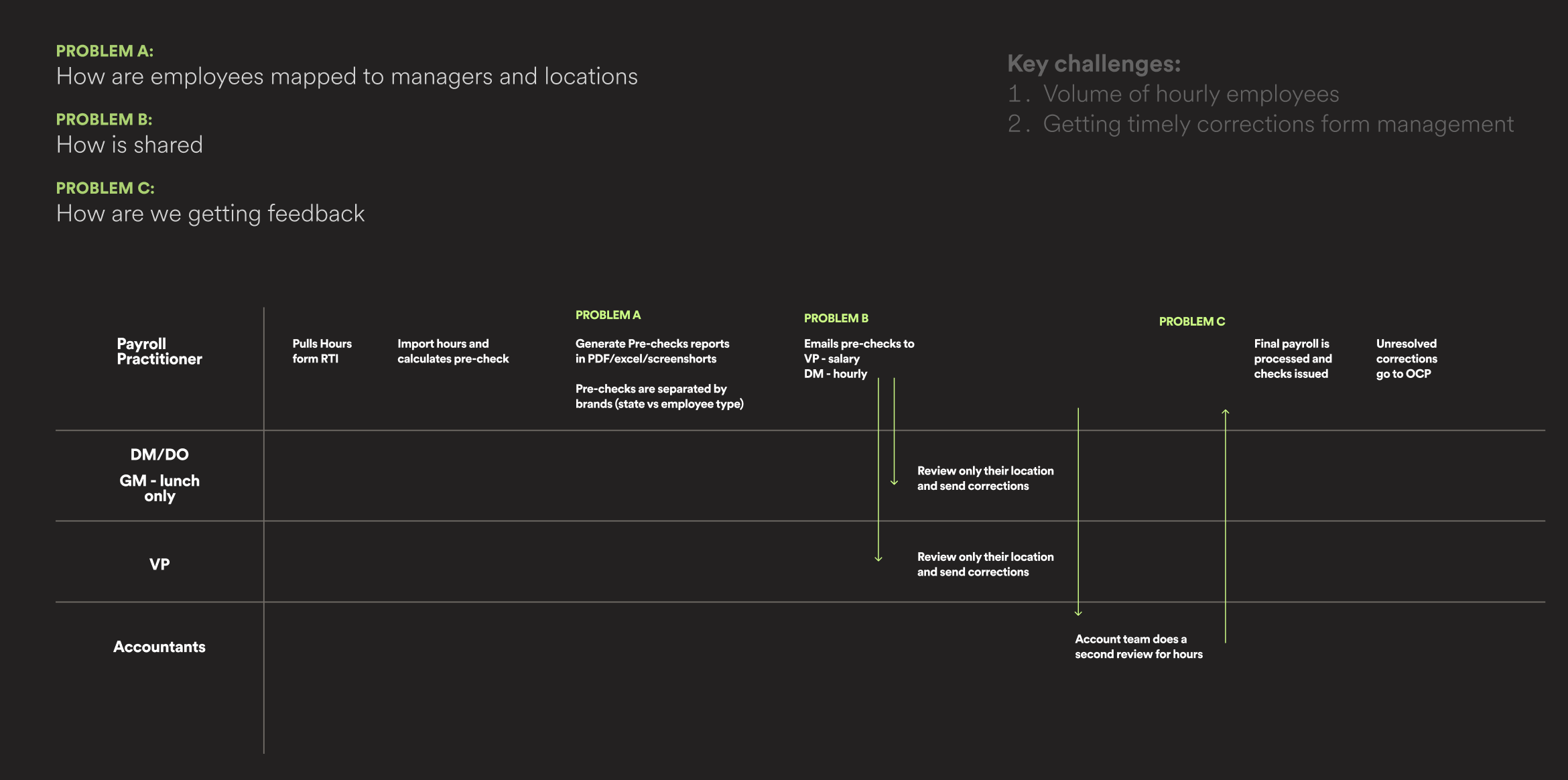
- Primary alignment artifact: process maps built from interview and shadowing notes
The strongest cross-functional outcome was aligning the team on the core problem: permissions and organizational mapping, secure sharing of payroll data, and a feedback loop between managers and payroll practitioners.
Final Solution
- Secure approval workflow embedded directly in the payroll run
- Mobile-first review experience for managers working on-site
- Permission model that prevents visibility into peers’ pay rates or hours
- Targeted review that highlights what managers actually check (hours, pay rate, overtime, PTO)
- Feedback loop between managers and payroll practitioners without leaving the system
The resulting experience reduced risk, reduced tool switching, and made approvals realistic under real manager time constraints.
Breakthrough
Visual maps of the current process aligned teams and focused discussions on the real problem, unlocking momentum toward a viable solution.
Prioritization Matrix
Impact
By moving approvals into a secure, guided workflow, the design reduced compliance exposure while fitting naturally into existing payroll routines.
Next Steps
- v2 prioritization: automatically surface only employees with changes or issues, rather than exposing the full payroll list
- Expand manager usability testing and refine mobile interaction patterns
- Track adoption and completion time by role to quantify long-term impact
Reflection
This project reinforced two patterns I now reuse. 1. Start by mapping the process to create shared clarity, and use co-creation to accelerate alignment and iteration under pressure.
My strength is quickly bringing order to complex enterprise systems, identifying the core problem, aligning teams, and delivering a secure, scalable workflow that fits real operational behavior.